

In the UK, government advice is that everyone over the age of four should consider taking a daily vitamin D supplement through autumn and winter [1]. In Ireland, the HSE advises everyone to take a daily vitamin D supplement: from Halloween to St Patrick's Day for adults under 65, and all year round from 65 [2].
Here's what vitamin D does, why it can be hard to get enough in winter, what the research does and doesn't show, and when a blood test can be useful.
What does vitamin D actually do?
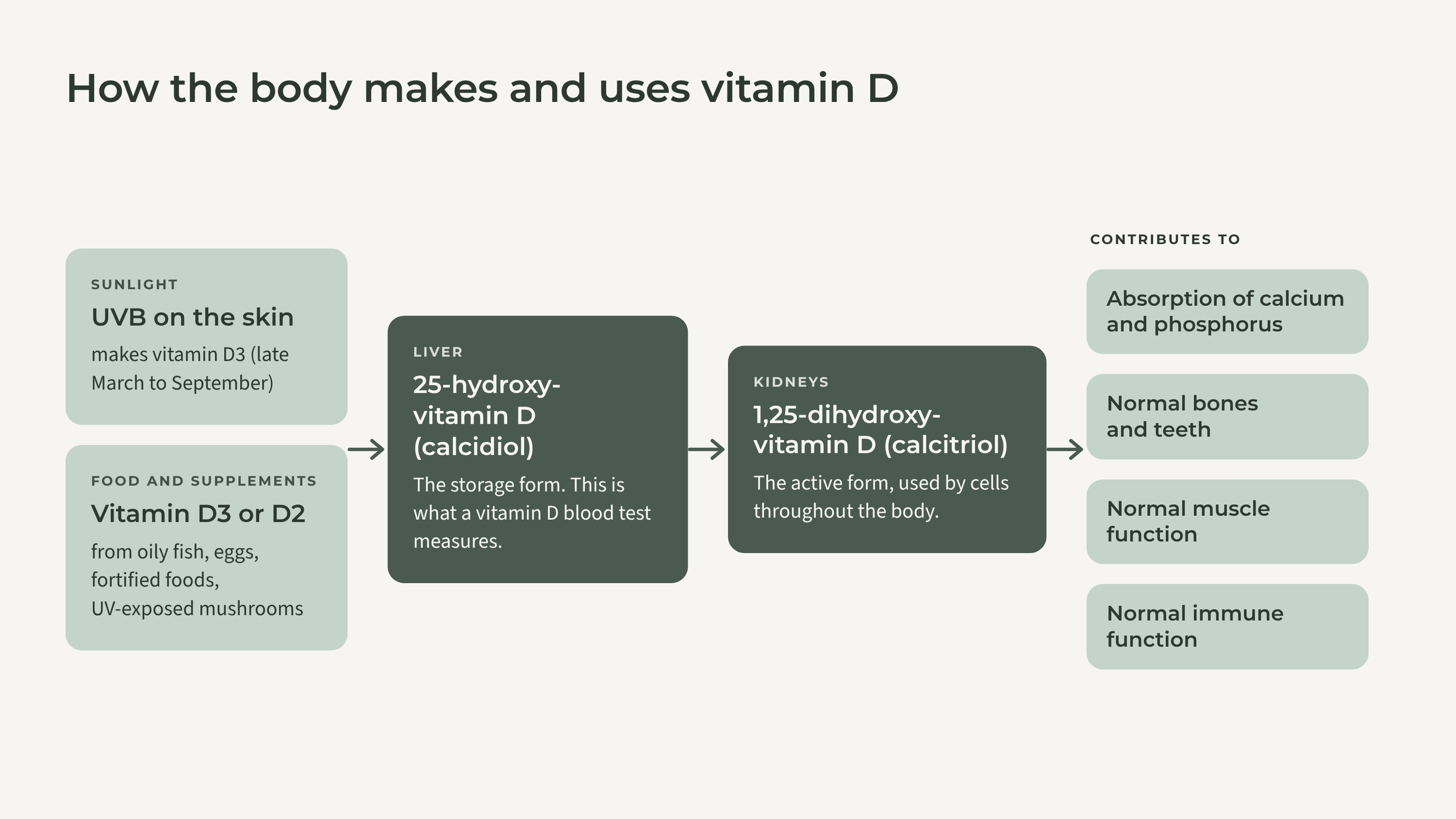
Vitamin D contributes to the normal absorption of calcium and phosphorus from food, and to the maintenance of normal bones, teeth and muscle function. When levels stay very low for a long time, bones can soften (a condition called osteomalacia) and muscles can weaken.
Vitamin D behaves more like a hormone than a typical vitamin, and it comes in two main forms. Vitamin D3 (cholecalciferol) is the form the skin makes from sunlight, and it is found in animal foods such as oily fish and eggs. Vitamin D2 (ergocalciferol) comes from plant sources, including UV-exposed mushrooms.
Both forms are inactive to start with. The liver converts them to 25-hydroxyvitamin D (calcidiol), the storage form that a blood test measures. The kidneys then convert this to 1,25-dihydroxyvitamin D (calcitriol), the active form the body uses. Cells throughout the body have receptors for calcitriol, including immune cells. Vitamin D contributes to the normal function of the immune system.
From midlife, bone density gradually declines, and the loss speeds up for women in the years after menopause. Looking after bone and muscle health becomes increasingly worthwhile from this point on.
Why is it harder to get enough vitamin D in a UK winter?
Most vitamin D comes from sunlight on the skin rather than from food. From around late March to the end of September, most people in the UK and Ireland can make enough by spending time outdoors [1]. From October to March, the sun sits lower in the sky, and the UVB rays needed to make vitamin D are too weak. During these months, the body relies on its summer stores and on food.
Few foods are naturally rich in vitamin D, so it is hard to get enough from diet alone. The main sources are oily fish, egg yolks, red meat, and fortified foods such as some breakfast cereals and spreads.
Several things make it harder still:
Time indoors. Long working days at a desk, driving to work, and dark mornings and evenings all reduce sun exposure, even in summer.
Darker skin. People with an African, African-Caribbean or South Asian background make less vitamin D from sunlight [1].
Covering up. People who usually cover most of their skin outdoors make less.
Body weight. People with a higher body weight tend to have lower blood levels of vitamin D [3], and may need a higher dose to reach the same level [4].
In the UK, nearly 1 in 5 adults aged 19 to 64 are deficient in vitamin D, rising to almost 1 in 3 between January and March [5]. In Ireland, 1 in 8 adults over 50 are deficient, rising to 1 in 4 in winter [6].
Can low vitamin D cause tiredness?
Low vitamin D can cause tiredness, aching bones and muscles, and muscle weakness, although some people with low levels have no symptoms at all [7, 8]. These signs often creep in gradually, so they are easy to put down to being busy, sleeping badly or simply getting older.
Tiredness has many possible causes, though, and low vitamin D is only one of them. Low iron, low vitamin B12 and an underactive thyroid can feel very similar, as can poor sleep, stress and blood sugar swings through the day.
Feeling worn out for weeks rather than days is a reason to see a GP and get checked. A few simple blood tests can rule the common causes in or out.
What about other areas of health?
The evidence for vitamin D's role in bones and muscles is strong. Because cells throughout the body respond to vitamin D, including immune cells, research is ongoing into its relationship with autoimmune conditions, respiratory infections and mood, among other areas. To date, the evidence in these areas is mixed and not yet strong enough to form the basis of official recommendations [9].
Why are the trial results so mixed?
Part of the answer lies in how the trials are designed. The body's response to a nutrient follows a curve: going from low to adequate makes a real difference, while topping up when levels are already adequate adds little. Unlike drug trials, nutrition trials start with people who already have some of the nutrient in their bodies, from food and, for vitamin D, from sunlight. Yet many trials don't recruit people based on their starting levels, and some don't measure them at all, which makes any effect much harder to detect [10]. In the UK, a blood level above 50 nmol/L is considered sufficient for almost everyone, and below 25 nmol/L is deficient [11]. Some experts argue the target should be higher [12], and individual requirements are likely to vary. The largest vitamin D trials mostly recruited people whose levels were already adequate. In VITAL, for example, the average starting level was 77 nmol/L, and only about 1 in 8 participants had levels below 50 nmol/L [13].
How much vitamin D is needed, and is testing worthwhile?
In the UK, the NHS advises that adults and children over four should consider a daily supplement of 10 micrograms (also written as 400 IU) through autumn and winter [1]. Some people are advised to take it all year round, including those who rarely get outside, those who cover most of their skin outdoors, and people with darker skin [1].
In Ireland, the HSE advises adults aged 13 to 64 to take 15 micrograms a day from Halloween to St Patrick's Day, and adults aged 65 and over to take 15 micrograms every day, all year round [2]. People with darker skin are advised to take it all year [2].
Both advise against taking more than 100 micrograms (4,000 IU) a day unless advised by a doctor, as too much can be harmful [1, 2].
This advice is a sensible baseline for everyone. Some people need more than this to bring their levels up, especially if they are already low. A blood test is the only way to know an individual's level, although routine testing isn't recommended for everyone.
A vitamin D blood test measures 25-hydroxyvitamin D, the storage form, which reflects levels over the past few weeks. There are two ways to get one:
Through a GP, for anyone with symptoms such as aching bones and muscles or ongoing tiredness, or in a higher-risk group.
Privately, with a home finger-prick kit that is posted to a lab.
The best time to test is towards the end of winter, when levels are usually at their lowest. If the result is low, a GP or qualified practitioner can advise on how much to take, for how long, and when to retest.
Actionable tips
Follow the winter advice. Take a daily vitamin D supplement through autumn and winter at the dose advised in the UK or Ireland, or all year round for anyone in a higher-risk group.

Eat vitamin D foods regularly. Have oily fish such as salmon, mackerel, sardines or trout once or twice a week, enjoy eggs, and check labels for fortified cereals, spreads and plant milks.
Try UV-exposed mushrooms. Some supermarkets sell mushrooms that have been exposed to UV light, which raises their vitamin D content. The label will say so.
Get outside in the warmer months. From late March to September, short spells of sun on the arms and face help build stores for winter. Cover up or use sun cream before the skin starts to redden or burn.
Look at the bigger picture. If tiredness is dragging on, ask a GP about other common causes, such as iron, B12 and thyroid function, as well as vitamin D.
Key Takeaways
Vitamin D contributes to normal bones, teeth and muscle function, and from October to March the sun in the UK and Ireland is too weak for the skin to make it, which is why a daily supplement is advised through autumn and winter. Some people need more than the standard dose, and for anyone with symptoms or risk factors, a blood test is the way to find out.
Sources
1. NHS. Vitamin D. Accessed November 2026.
2. HSE. Vitamin D. Accessed November 2026.
3. Vimaleswaran KS, Berry DJ, Lu C, et al. (2013). Causal relationship between obesity and vitamin D status: bi-directional Mendelian randomization analysis of multiple cohorts. PLOS Medicine, 10(2), e1001383.
4. Walsh JS, Bowles S, Evans AL (2017). Vitamin D in obesity. Current Opinion in Endocrinology, Diabetes and Obesity, 24(6), 389–394.
5. Office for Health Improvement and Disparities (2025). National Diet and Nutrition Survey 2019 to 2023 report. Winter figure for adults aged 19 to 64 as reported by the University of Cambridge Epidemiology Unit.
6. Laird E, O'Halloran AM, Carey D, et al. (2018). The prevalence of vitamin D deficiency and the determinants of 25(OH)D concentration in older Irish adults: data from The Irish Longitudinal Study on Ageing (TILDA). Journals of Gerontology: Series A.
7. Patient.info Vitamin D deficiency. Accessed November 2026.
8. NHS Tayside. Vitamin D. Accessed November 2026.
9. Scientific Advisory Committee on Nutrition (2016). Vitamin D and Health. Public Health England.
10. Heaney RP (2014). Guidelines for optimizing design and analysis of clinical studies of nutrient effects. Nutrition Reviews, 72(1), 48–54.
11. Royal Osteoporosis Society (2020). Vitamin D and bone health: a practical clinical guideline for patient management.
12. Holick MF, Binkley NC, Bischoff-Ferrari HA, et al. (2011). Evaluation, treatment, and prevention of vitamin D deficiency: an Endocrine Society clinical practice guideline. Journal of Clinical Endocrinology & Metabolism, 96(7), 1911–1930.
13. Manson JE, Cook NR, Lee IM, et al. (2019). Vitamin D supplements and prevention of cancer and cardiovascular disease. New England Journal of Medicine, 380(1), 33–44.